

CRETEM AP · HIGH-CAPACITY POUCH PACKAGING
Room for up to 500 medicines.
One pouch workflow.
Dedicated cassettes for 207 to 500 medicines, Free Shape Packing and a Manual Divide Unit in one cabinet. Choose the capacity that fits your medication list today and the list you’re growing into.
- 207 → 500
- Cassette positions across five models
- 33.1 × 40.6 in
- Footprint · AP-500FS is 43.3 in wide
- 60 pouches/min
- Maximum unit-dose packaging speed
- 1–2 FSP + MDU
- 30- or 60-cell Manual Divide Unit
BUILT FOR A LARGE MEDICATION LIST
More medicines in cassettes. Fewer by hand.
For pharmacies packaging a broad, busy medication list, AP keeps more medicines in dedicated cassettes and gives the rest a clear route into the same pouches.
- 01
Capacity in five steps
207, 267, 336, 405 or 500 dedicated positions, each holding one medicine in a small, medium or large cassette.
- 02
Access on more than one face
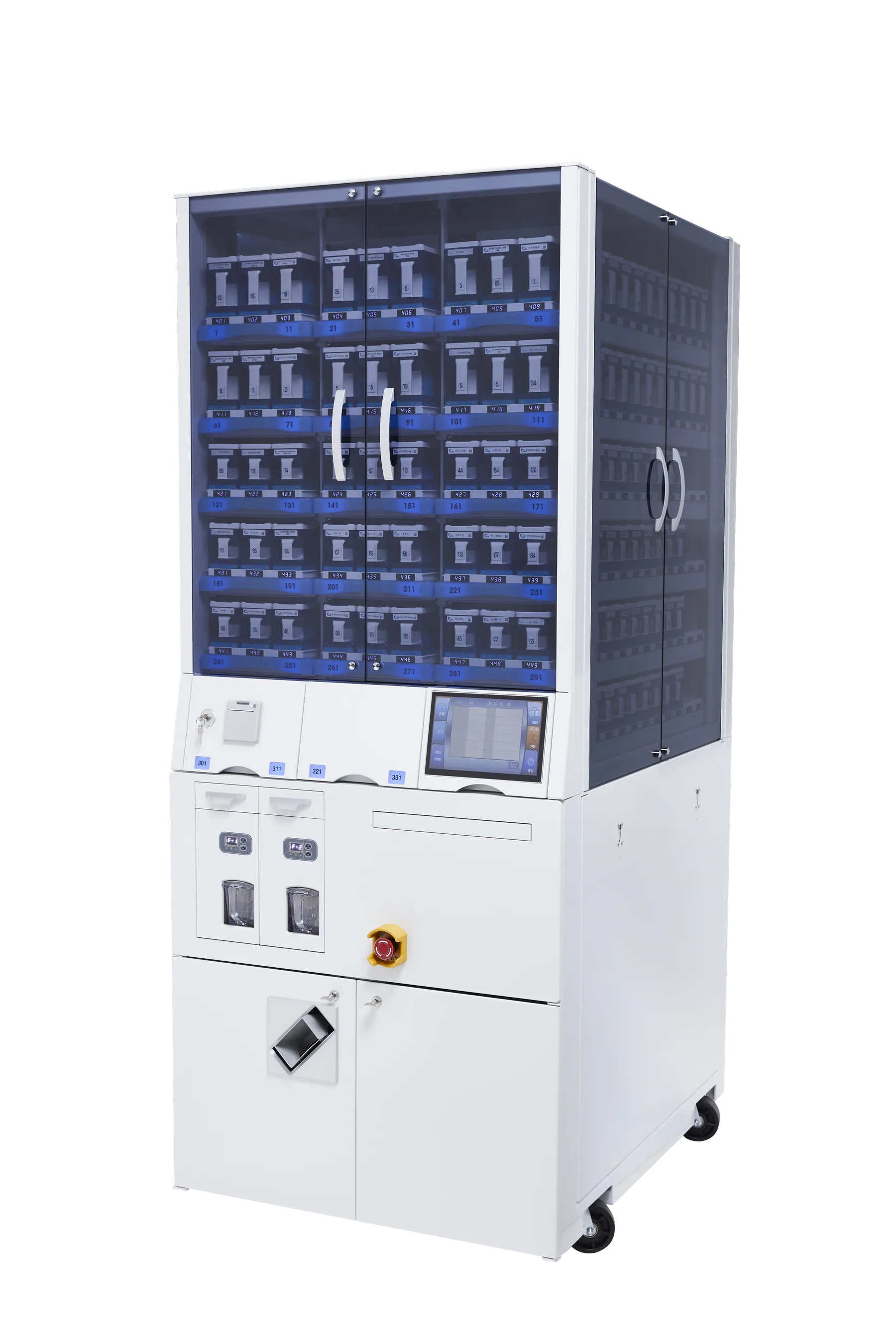
T-slide drawers bring cassettes forward for refilling and cleaning. The AP-405FS pictured has cassette doors on the front and side.
- 03
A route for everything else
One or two Free Shape Packing units and a 30- or 60-cell Manual Divide Unit handle suitable half tablets and low-volume medicines.
KNOW THE CABINET
Every working part, at a glance.
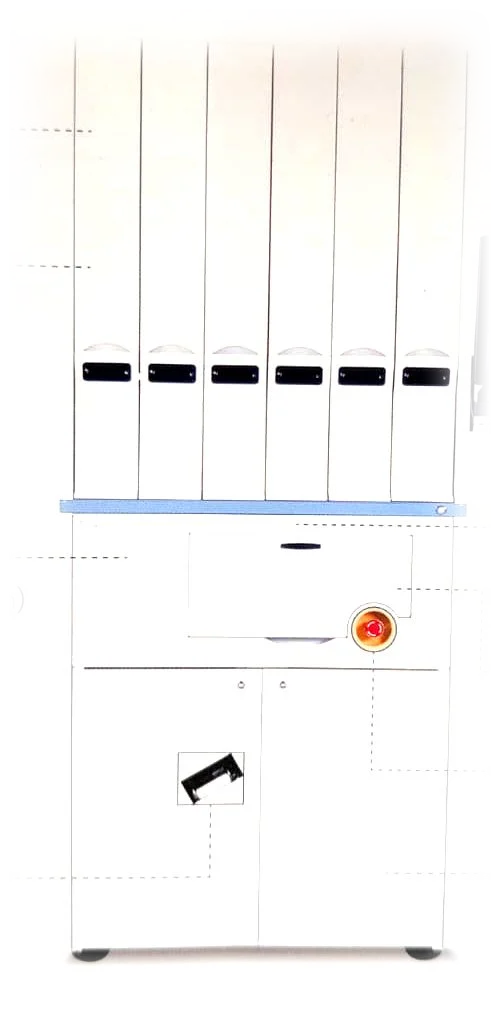
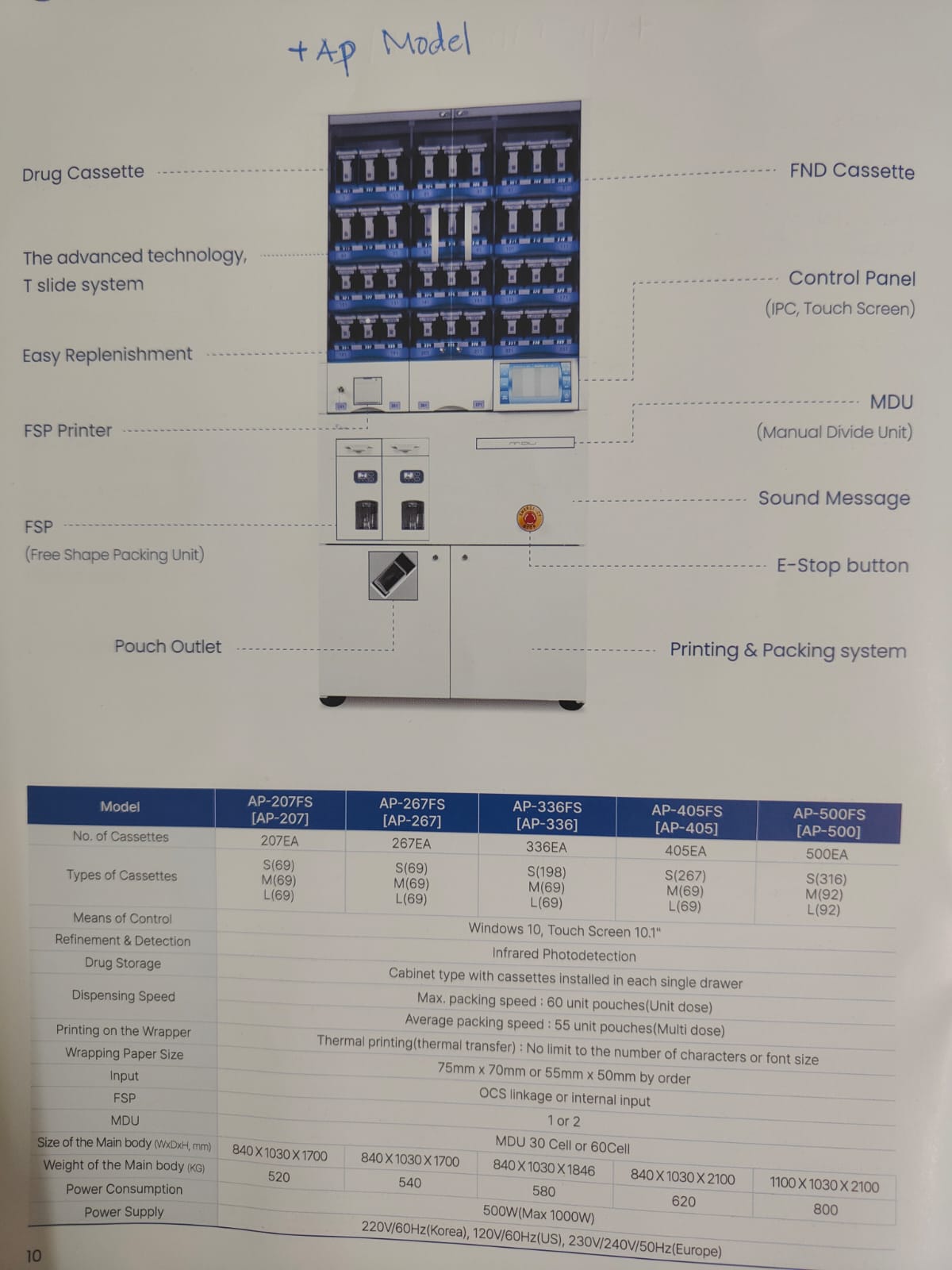
From the cassette bank to the pouch outlet, see where each step happens before you explore the details.
PRODUCT FEATURES
The detail behind each part.
Explore the cassette system, controls, printing and care. Component photographs show the shared CRETEM FS-series platform.
Small, medium and large cassettes accommodate the configured medication mix. The brochure describes a tablet-stopper mechanism for controlled dispensing; suitability and cassette setup are reviewed for each medication.
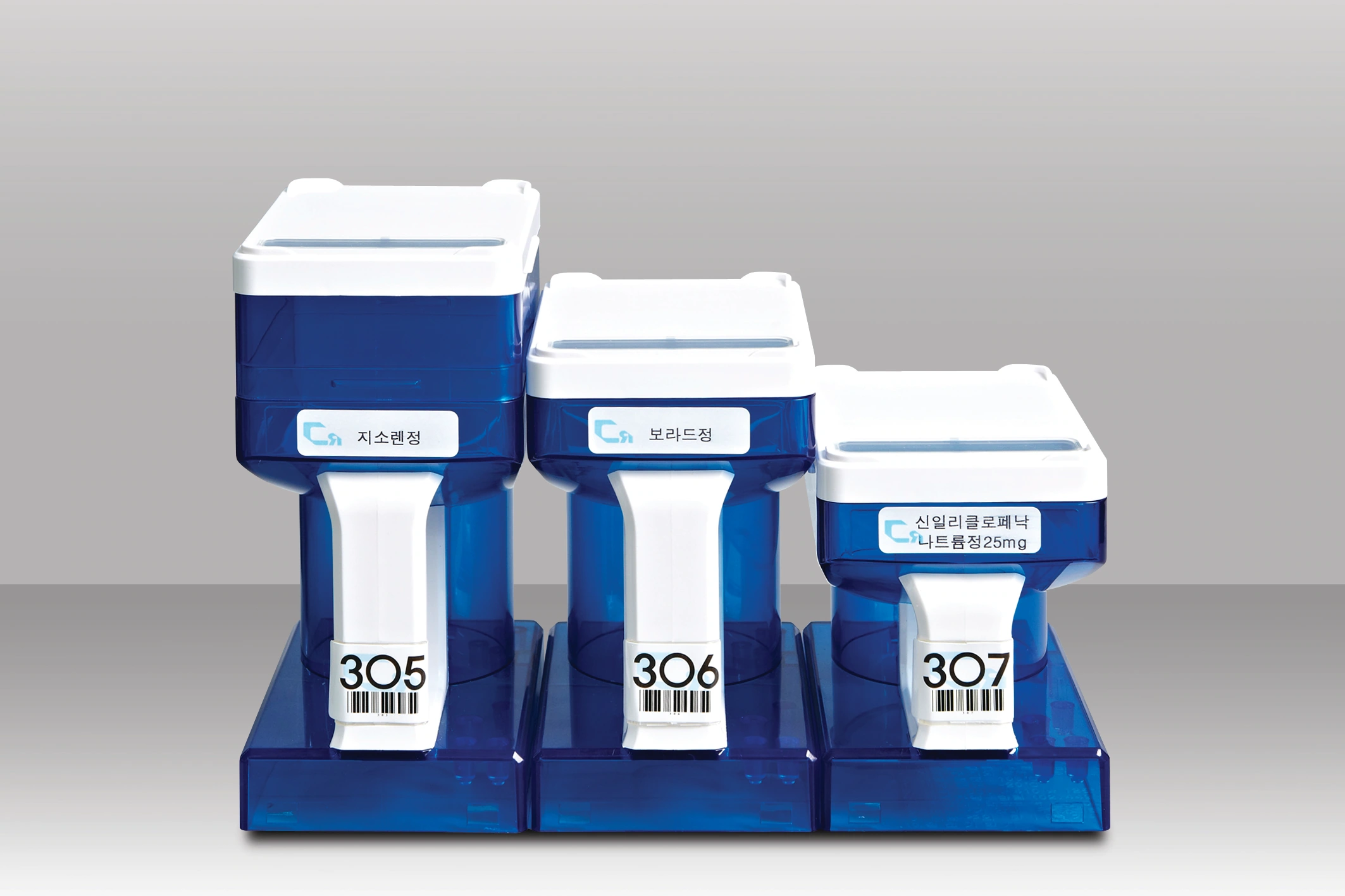
Dedicated medication cassettesShared FS-series component detail Flexible Numeric Display (FND) cassettes use numeric displays and unique identification chips. Compatible front positions help organise frequently replenished medicines. Confirm the supplied FND arrangement.
Draw cassettes forward from the cabinet face to replenish medicines and access the front and sides for cleaning. Plan working clearance for the open drawers, not just the closed cabinet.
Infrared photodetection monitors the dispensing path. This is different from checking the identity and contents of the finished pouch; your pharmacy’s verification remains part of the process.
FSP handles suitable half tablets, irregular shapes and low-frequency medicines without assigning an additional dedicated cassette. The supplied platform brochure also describes automatic collection of remaining medicines. Confirm medication suitability and the module arrangement.
Staff prepare the numbered MDU tray for suitable medicines that are not dispensed from cassettes. Choose the specified 30- or 60-cell arrangement around the manual preparation work in your pharmacy.
FROM ORDER TO POUCH
One connected packaging sequence.
Automatic dispensing and packaging sit within your team’s preparation, verification and release process.
- STEP 01
Receive the order
Use the agreed OCS interface or enter the packaging order on the touchscreen.
- STEP 02
Dispense from cassettes
Configured medication cassettes dispense through an infrared-monitored path.
- STEP 03
Add non-cassette items
Load suitable medicines into the FSP units for automatic dispensing, or fill the MDU tray by hand. Both join the same pouches.
- STEP 04
Print and seal
Print the configured information and seal the medication pouches.
- STEP 05
Check and release
Complete content checks, exception handling and the pharmacy’s release procedures.
See a large list run through AP.
Ask to see order entry, cassette dispensing, FSP and MDU preparation, printing and pouch output with representative prescriptions.
CHOOSE YOUR AP CONFIGURATION
Five capacities. Find the one that fits.
Enter how many medicines you keep in cassettes and how many you plan to add. See all five models side by side, drawn to the same scale.
280cassette positions neededOne medicine per cassette
Front views to scale. AP-500FS is the wider 1,100 mm body.
Your fit
AP-336FS
- Positions
- 336
- Spare
- 56
- Height
- 72.7 in
Fits all 280: your 240 today and 40 planned.
Cassettes: S 198 · M 69 · L 69. MAXIS confirms the size each medicine needs.
SPECIFICATIONS AT A GLANCE
Compare all five models.
Capacity, cassette sizes, dimensions and weight side by side, from the supplied AP series specification. On smaller screens, scroll the table sideways.
| Model | AP-207FS | AP-267FS | AP-336FS | AP-405FS | AP-500FS |
|---|---|---|---|---|---|
| Medication cassettes | 207 | 267 | 336 | 405 | 500 |
| Cassette mix · small / medium / large | 69 / 69 / 69 | 129 / 69 / 69 | 198 / 69 / 69 | 267 / 69 / 69 | 316 / 92 / 92 |
| Control panel | 10.1-inch touchscreen; supplied brochure lists Windows 10. Confirm supplied OS and support lifecycle. | ||||
| Dispensing detection | Infrared photodetection | ||||
| Medication storage | Dedicated cassettes in cabinet drawers; front T-slide access | ||||
| Packaging speed | Up to 60 unit-dose pouches/min; brochure average 55 multi-dose pouches/min | ||||
| Pouch printing | Thermal transfer; configurable printed content and layout | ||||
| Wrapping paper size | 75 × 70 mm; 55 × 50 mm by order | ||||
| Order input | OCS (Order Communication System) linkage or internal entry; confirm interface compatibility | ||||
| Free Shape Packing (FSP) | 1 or 2 units, depending on configuration | ||||
| Manual Divide Unit (MDU) | 30 or 60 cells, depending on configuration | ||||
| Main body · W × D × H (mm) | 840 × 1,030 × 1,700 | 840 × 1,030 × 1,700 | 840 × 1,030 × 1,846 | 840 × 1,030 × 2,100 | 1,100 × 1,030 × 2,100 |
| Main body · W × D × H (ft, approx.) | 2.76 × 3.38 × 5.58 | 2.76 × 3.38 × 5.58 | 2.76 × 3.38 × 6.06 | 2.76 × 3.38 × 6.89 | 3.61 × 3.38 × 6.89 |
| Published machine weight | 520 kg | 540 kg | 580 kg | 620 kg | 800 kg |
| Listed power consumption | 500 W; maximum 1,000 W | ||||
| Regional supply options | 220 V / 60 Hz (Korea); 120 V / 60 Hz (US); 230–240 V / 50 Hz (Europe). Confirm the supplied electrical configuration. | ||||
| Manufacturer / origin | CRETEM / Republic of Korea | ||||
PLAN THE SPACE
Will it fit in your pharmacy?
AP is a big cabinet, up to 82.7 in tall. Here’s how it gets in, even through a standard door, and what the room needs around it.
Showing
Can it get in? Two ways to deliver it.
Measure the narrowest door, lift or corridor between the street and where the machine will stand.
Illustration. MAXIS confirms the number and size of sections for your route.
Good news: it gets in, delivered in sections.
The complete cabinet is 2.7 in too low for your 36 × 80 in door, so it arrives in parts and is assembled where it stands.
Delivered complete Quickest set-up
Arrives as one assembled cabinet. Needs an opening at least 33.1 in wide and 82.7 in high all the way in.
Needs a taller or wider openingDelivered in sections Through standard doors
Arrives in parts that pass through standard doors, lifts and corridors. The installation team assembles and connects it where it will stand.
Suits your doorWhat does the room need?
Four things to share with your landlord, engineer and IT team.
Floor space
33.1 × 40.6 in
Plus working room in front for drawers, FSP, MDU and pouch collection, and at the side for the cassette doors. 82.7 in tall: check shelves and lights above.
A floor that takes the weight
1,367 lb
620 kg on that footprint. Ask your landlord or engineer to confirm the floor.
Power and network
500 W
1,000 W maximum, plus a network link to your pharmacy software. Backup power (UPS) for connected computers is worth planning.
Work areas around it
4 to plan
A bench for refilling cassettes, storage for pouch rolls and labels, a cart for finished pouches, and waste bins.
Send us your measurements
We’ll plan the delivery and set-up with you.
PLAN THE COMPLETE INSTALLATION
A good fit goes beyond the cabinet.
Bring your floor plan, medicine list and pharmacy software details. Build the proposal around the equipment and the work around it.
Connect your software
Share your pharmacy software and version. Confirm the OCS interface or internal entry, prescription fields, network requirements and representative test orders.
Explore integration planningPrepare your pharmacy
Plan delivery access, floor loading, clearances on each face, electrical supply and IT. Agree cleaning, cassette replenishment, printer care and operator training.
Talk through site requirementsUnderstand the total cost
Include setup, integration, wrapping material, print ribbon and ongoing service. Validate pouch format and printing with samples from the proposed configuration.
Explore the ROI calculatorMAXIS AFTER-SALES SUPPORT
Support for the everyday.
- One-year limited company warranty
- After-sales service and spare parts
- Consumable supply
- Annual service support for an additional fee
Warranty terms, exclusions, service scope and annual fees are provided with your proposal.
BEFORE YOU DECIDE
Your questions. Clearer answers.
The practical details of choosing, installing and working with AP.
Which AP configuration should I choose?
The supplied range offers 207, 267, 336, 405 or 500 cassette positions. Compare the medicines you regularly package, the cassette-size mix, manual additions and available installation space. Cassette count is medication capacity, not a fixed patient limit.
Do all AP configurations have the same footprint?
No. AP-207FS, 267FS, 336FS and 405FS have a listed main-body width of 840 mm and depth of 1,030 mm. AP-500FS is 1,100 mm wide with the same depth. Heights and weights also differ. Working, service and installation clearances are additional.
Can I expand an AP-207FS into an AP-500FS later?
The supplied sheet lists five configurations rather than an in-place expansion path. AP-500FS also has a wider cabinet. Ask MAXIS about actual upgrade options for the proposed machine; do not assume CAP(EX)’s extension arrangement applies.
How does AP compare with WAP or AP MD?
The supplied AP range provides 207–500 cassette positions with a 1,030 mm main-body depth. WAP is the shallower 460 mm-deep range with 144–224 positions. AP MD is a separate cabinet range with its own configurations; compare the actual model sheets, loading requirements and options rather than assuming interchangeability.
What packaging speed is published?
The supplied AP sheet lists up to 60 unit-dose pouches per minute and an average of 55 multi-dose pouches per minute. These are packaging figures. Manual preparation, refills, checking, cleaning and the prescription mix affect end-to-end throughput.
How do FSP and MDU handle non-cassette medicines?
Free Shape Packing handles suitable half tablets, irregular shapes and other non-cassette medicines. Staff prepare the numbered Manual Divide Unit tray. The supplied AP range lists 1 or 2 FSP units and a 30- or 60-cell MDU. Confirm the selected arrangement and medicine suitability before purchase.
Does AP automatically repack error pouches?
The supplied FS-series feature material describes automatic repacking after recognised packing errors. Ask MAXIS to demonstrate the detected error types, medicine recovery and any operator intervention on the proposed AP configuration. This does not replace finished-pouch checks and final release.
Are sound messages and stock management included?
The platform brochure describes sound and recorded voice messages. It identifies barcode/server/electronic-balance stock management as optional. Confirm the software, hardware and alert configuration included in the quotation rather than assuming all functions are standard.
Will AP connect to our pharmacy software?
The supplied sheet lists OCS (Order Communication System) linkage or internal order entry. Share the exact software name and version, data fields, IT requirements and sample prescriptions with MAXIS. Confirm the interface and acceptance tests for the actual AP configuration.
What should we plan for installation?
Confirm the current model revision, cassette/FSP/MDU arrangement, access route, main-body and installed dimensions, floor loading, operating clearances, electrical supply and network. The supplied range lists 520–800 kg and 500 W consumption, with a maximum of 1,000 W; the actual machine’s requirements govern installation.
Why do published AP specifications differ?
AP is offered in different revisions and regional configurations. This page uses the supplied five-model AP sheet and cross-checks cassette mixes with CRETEM’s manufacturer listing. Other listings include an AP-158FS or different FSP, MDU, weight and dimensions. Confirm the exact configuration in your proposal.
What ongoing materials and support are needed?
Plan approved wrapping material, thermal-transfer ribbon, cleaning, cassette replenishment and routine printer maintenance. Confirm operator training, warranty, spare parts, service scope and recurring costs with MAXIS. Published wrapper sizes are 75 × 70 mm, with 55 × 50 mm by order.
COMPARE YOUR OPTIONS
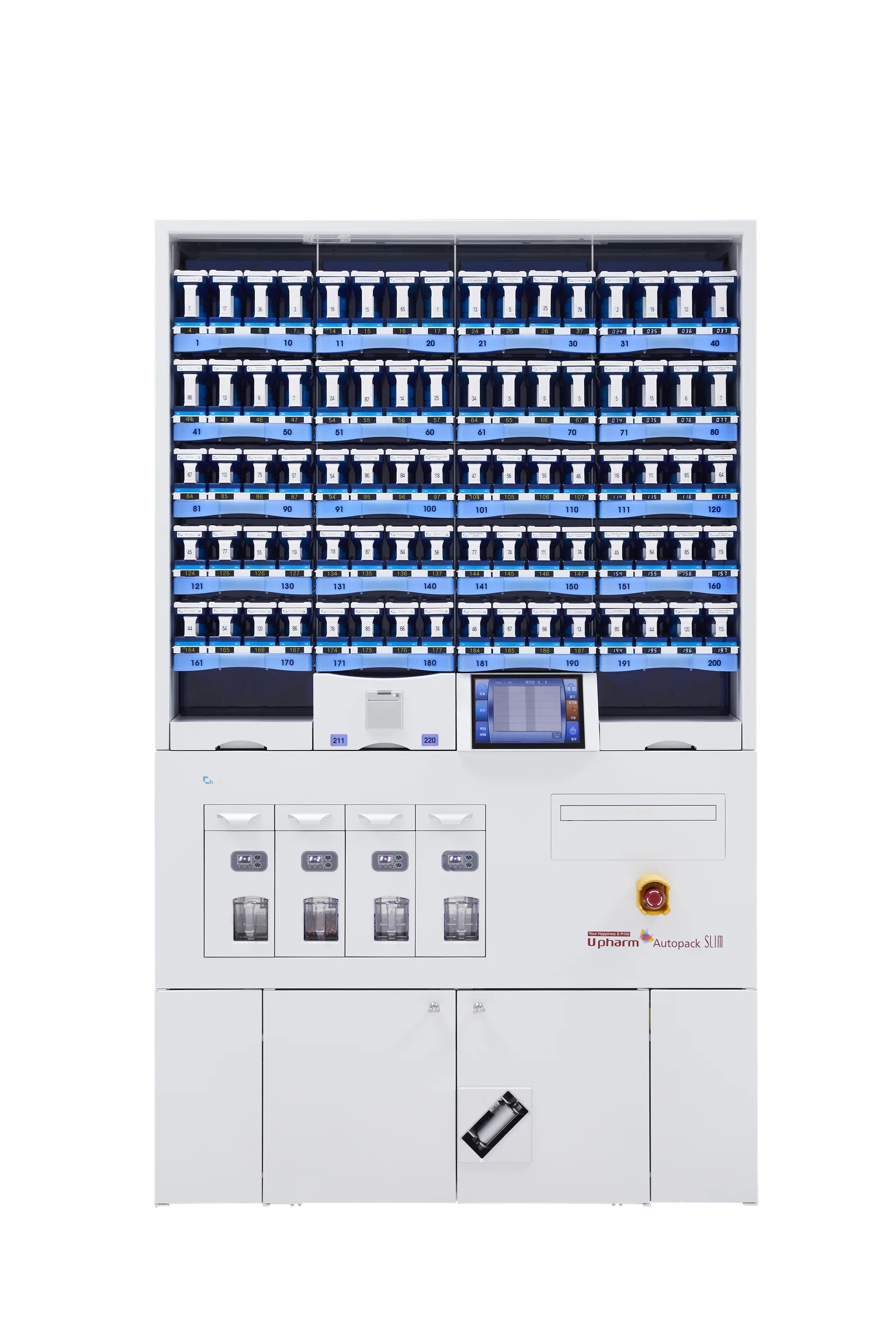
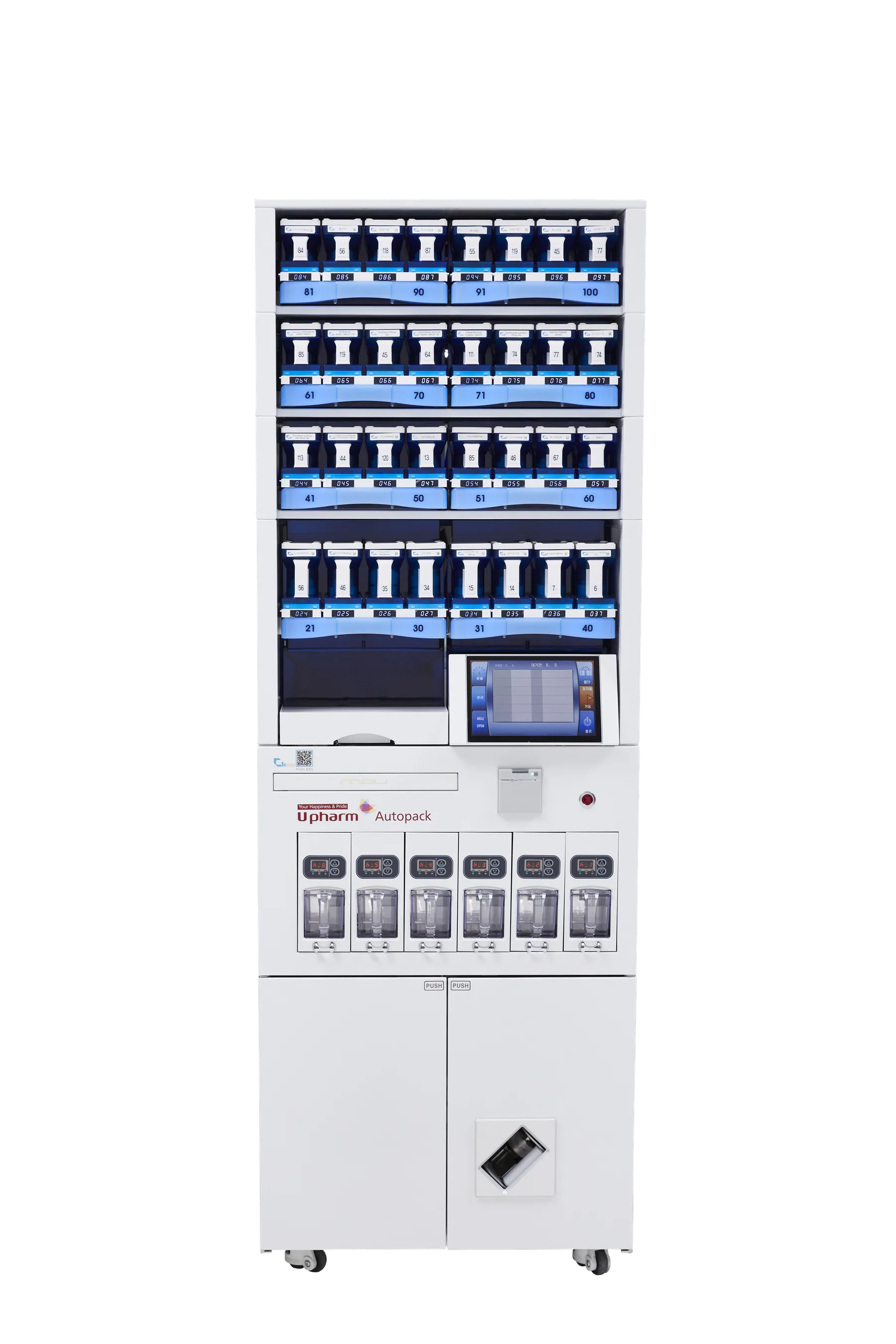
Different capacity. The same focus on fit.
YOUR MEDICATION LIST. YOUR FLOOR PLAN.
Let’s find the AP that fits.
Bring your medication list, workload and available space.
We’ll help you choose and plan the right AP configuration.